A strong founder can build the wrong product with remarkable efficiency. The usual failure is not poor execution. It is treating a few enthusiastic conversations, a growing keyword, or a competitor’s funding round as proof of a market. This startup diligence guide for founders is built to prevent that mistake.
Diligence is not a slide deck exercise for investors. It is the work required before you commit engineering time, ad spend, a hiring plan, or your reputation to a market thesis. The goal is not to prove your idea is good. The goal is to find the evidence that could make it a bad bet while there is still time to change course.
1. Define the decision before gathering data
Research without a decision criteria produces interesting facts and weak choices. Start by writing the specific decision you need to make: build, reposition, test a narrower segment, enter a new geography, or walk away.
Then define what would qualify as a Go, No-Go, or conditional test. For example, a B2B workflow tool may require evidence that a defined buyer has a recurring, costly problem, that the market can support a price above $200 per month, and that customer acquisition is plausible without an enterprise sales team. A consumer product may need repeat purchase signals and lower paid acquisition costs.
The thresholds depend on your model. A bootstrapped founder can pursue a small, profitable niche that venture economics would reject. A venture-backed company needs evidence of a much larger outcome. The mistake is using the same standard for both.
2. Separate real demand from visible interest
Search volume, social engagement, waitlist signups, and survey responses are signals. None is demand on its own.
Start with the language buyers use when they are trying to solve the problem. Search demand can reveal whether people actively seek a solution, how demand is changing, and whether demand concentrates around a pain point, a job to be done, or an existing category. But a high-volume keyword can also indicate a market dominated by free information, low-intent researchers, or buyers looking for something your product does not provide.
Look for commercial behavior alongside attention. Are people comparing tools? Asking for recommendations? Searching for pricing, alternatives, implementation help, or a specialist provider? Are they already paying agencies, consultants, or software vendors to manage the problem? Existing spend is usually more meaningful than stated interest.
Customer reviews, support threads, community discussions, and job postings add context. Repeated complaints about slow workflows, missing integrations, opaque pricing, or unreliable service can identify an opening. A complaint only matters if the affected customer has money, authority, and urgency to act.
3. Map the competitor reality, not the competitor list
A search for competitors often returns a list of companies with similar product descriptions. That is not competitive diligence. Your real competitors include internal spreadsheets, manual labor, agencies, incumbents with adjacent products, and the buyer doing nothing.
Assess competitors on four dimensions: what segment they serve, how they acquire customers, what they charge, and where customers say they fall short. A crowded market is not automatically a bad market. Competition can validate buyer willingness to pay. But it raises the standard for your differentiation and distribution plan.
Pay close attention to competitor traffic sources. If category leaders win primarily through organic search, a new entrant may have a viable content and search strategy, but it may take time. If they rely on branded demand, partnerships, or large sales teams, copying their growth path may be unrealistic. If paid advertising is active across many competitors, that can indicate commercial intent, but it can also signal expensive customer acquisition.
The useful question is not, "Can we build a better product?" It is, "Why will a specific buyer switch, and how will we reliably reach them before our runway runs out?"
4. Test whether the market is large enough for your actual goal
Top-down market size figures are often too broad to guide a startup decision. A report claiming a multibillion-dollar industry does not mean your product can access meaningful revenue.
Build the estimate from the bottom up. Define the customer type, the number of reachable accounts or buyers, the percentage with the relevant problem, the realistic annual contract value, and the share you could plausibly win. Use ranges rather than a single impressive number.
For example, a tool aimed at independent dental offices is not selling into all healthcare software spend. It is selling to a defined count of offices with a particular workflow, budget, and purchasing process. If only a small portion can buy at your required price, your market may still work for a focused business. It may not support the growth expectations of an institutional funding model.
Market size should also account for expansion paths. A narrow initial wedge is often sensible if adjacent segments share the same product architecture, channel, and buyer. It is less credible if each new segment requires a different product, sales motion, and compliance model.
5. Pressure-test pricing before building features
Founders frequently set pricing by looking at competitor price pages and choosing a number slightly lower. That is not pricing research. It is a margin decision disguised as positioning.
Start with the economic value of the problem. Does your product save labor, reduce costly errors, increase conversion, accelerate revenue, or reduce risk? A customer paying $500 per month needs a clear reason the product creates far more than $500 in value. If the value is hard to quantify, buyers may treat the product as discretionary, which makes retention fragile.
Competitor pricing still matters because it establishes the market’s reference points. Review plans, packaging, free tiers, onboarding fees, contract terms, and feature gates. A low advertised price may be a lead-generation tactic rather than the company’s realized revenue. Enterprise vendors may conceal their actual pricing because implementation, support, and procurement are part of the sale.
Talk to prospects about their current spend and the cost of the status quo. Do not ask, "Would you pay $99?" Ask what they use now, what it costs, who approves the purchase, and what budget would fund a replacement. Their operating reality is more useful than a polite hypothetical answer.
6. Model distribution as rigorously as the product
A good market with no credible route to customers is not a Go. It is an unresolved risk.
Name the first channel you expect to work and explain why your team has an advantage there. It could be founder-led outbound to a narrow account list, organic search around high-intent queries, a channel partner, an audience you already own, or a community with trusted access. "We will use LinkedIn and content" is not a channel strategy. It is a placeholder.
Estimate the operating mechanics. How many prospects can you reach each week? What conversion rate is plausible at each stage? How long is the sales cycle? What proof will buyers need before they commit? For self-serve products, estimate activation and the time to first value. For B2B products, identify whether security review, integrations, or executive approval will delay revenue.
Distribution evidence can change your idea. If search demand exists but the results are dominated by entrenched publishers, paid acquisition may be necessary. If outbound is the path but the buyer list is small, pricing and retention must support the effort. Every channel has a cost, even when it looks free.
7. Write down the deal-breakers and run the smallest proof test
The final stage of this startup diligence guide for founders is not a confidence score generated from optimism. It is a clear record of the assumptions that could break the business.
Common deal-breakers include a buyer with no budget authority, high switching costs, a market dependent on one platform, legal or regulatory exposure, long procurement cycles, weak retention potential, or an acquisition channel that cannot scale. Rank each risk by impact and uncertainty. Then choose the fastest test that can reduce the most dangerous uncertainty.
That test may be a paid pilot offer, a landing page aimed at one buyer segment, ten structured buyer interviews, a concierge service, or a limited outbound campaign. It should create behavior, not compliments. A prospect who schedules a meeting is a better signal than a survey response. A prospect who commits budget is better still.
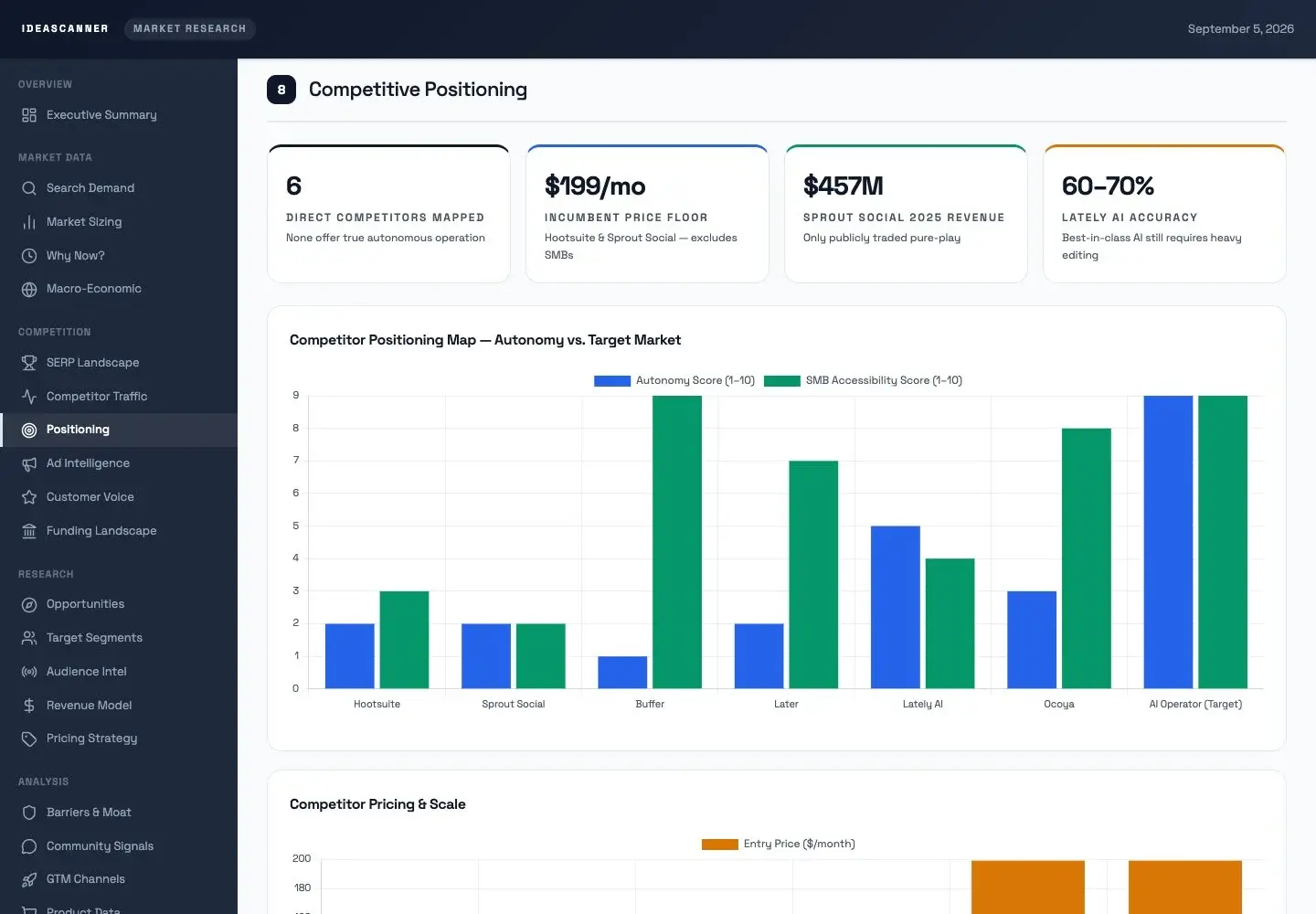
Tools such as IdeaScanner can compress the desk-research portion by cross-checking live demand, traffic, pricing, advertising, customer voice, and market signals into a decision-ready view. But no report can substitute for a test when the unanswered question is whether your particular offer will earn a commitment.
The discipline is simple: do not build to discover whether the market exists. Build only the minimum proof required to decide whether the next investment is justified. A No-Go reached early is not a failed idea. It is capital, time, and focus preserved for the opportunity that can survive scrutiny.