Most bad product decisions do not start with bad execution. They start with false validation. A few enthusiastic interviews, a good response from your network, or a generic AI answer can make an idea look stronger than it is. Data backed product validation exists to stop that. It forces the question founders actually need answered: is there enough real market evidence to justify spending time, money, and focus here?
That sounds simple. In practice, it is where most teams get sloppy. They look for proof that the idea could work, not evidence that it should. Those are not the same thing.
What data backed product validation actually means
Data backed product validation is the process of testing a product idea against measurable market signals before major commitment. Not vibes. Not isolated anecdotes. Not one metric pulled out of context. You are looking for converging evidence across demand, competition, pricing, customer pain, acquisition channels, and commercial viability.
The key word is converging. Search demand without pricing power can mislead you. Strong ad activity without real customer dissatisfaction can hide a crowded market. Positive interview feedback without competitor traction often means people like the concept but will not switch behavior. A founder who only checks one box is not validating a market. They are looking for comfort.
Real validation is closer to diligence than brainstorming. It asks whether the market is active, whether buyers are spending, whether incumbents are winning efficiently, and whether there is room for a new entrant to carve out a position that is commercially sensible.
Why founders get validation wrong
Most validation fails because the process is built backward. The founder starts emotionally attached to the idea, then gathers evidence selectively. That bias shows up everywhere.
Customer interviews become leading conversations. Keyword research gets interpreted as demand for a specific solution rather than broad curiosity. Competitor reviews get skimmed for feature gaps instead of retention signals. Even pre-orders can be misleading if the audience came from a warm network or a one-time launch spike.
The other problem is speed without rigor. Founders move fast, which is usually good. But fast can become careless when the research stack is thin. One search volume tool, one Reddit thread, and a few AI-generated market claims are not enough to support a build decision. They might help shape a hypothesis. They should not approve budget.
That is why data backed product validation matters most before development gets expensive. The earlier you pressure-test the opportunity, the cheaper your mistakes are.
The signals that matter most
If you want a market read that holds up, you need to evaluate multiple signal types together.
Demand needs depth, not just volume
Search demand is useful, but raw volume can be deceptive. You need to know whether searches are growing, flattening, or fading. You also need to separate informational queries from transactional intent. Ten thousand searches for a broad problem is less valuable than a smaller cluster of high-intent searches tied to a clear buying need.
Demand should also be segmented. National interest may look healthy while your actual niche is thin. A B2B tool serving dental practices, for example, should not rely on broad demand for practice management software. It needs evidence that its exact segment is active enough to support acquisition and retention.
Competitor traction reveals whether the market is real
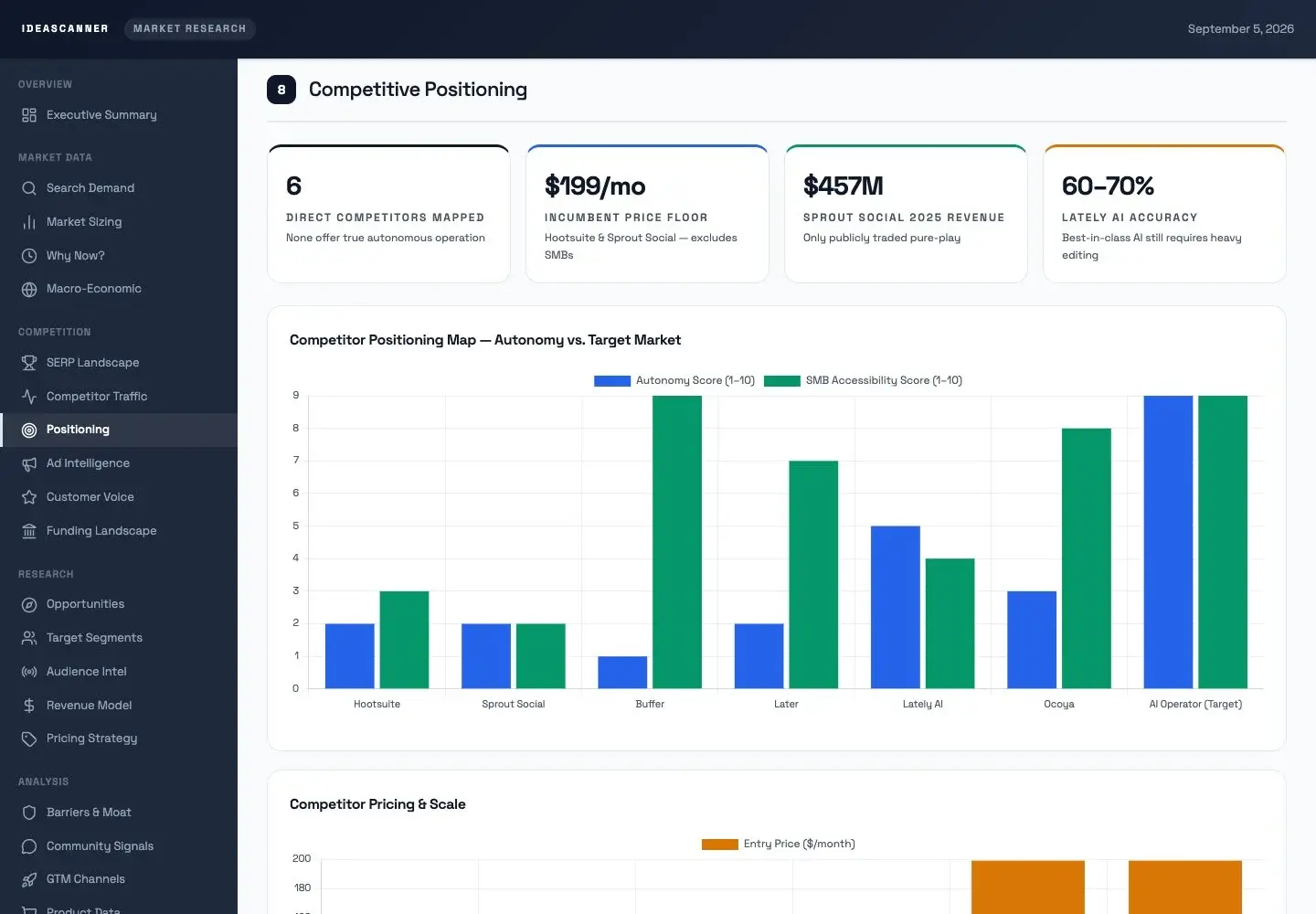
Competitive presence is not automatically bad. In many cases, competition is proof that money moves in the category. What matters is the shape of that competition. Are a few players dominating all traffic? Are there fragmented mid-market winners? Are newer entrants gaining ground through specific channels or positioning?
Traffic trends, content footprint, paid activity, pricing, review velocity, and product breadth all tell a story. If every serious competitor is spending aggressively on paid search, that affects your customer acquisition assumptions. If traffic is concentrated around educational content, that suggests the market needs trust and explanation before conversion. If pricing is converging tightly, differentiation may be hard.
Pricing is a validation signal, not just a monetization decision
Founders often treat pricing as something to figure out later. That is a mistake. Pricing tells you whether the problem is painful enough to command budget. It also tells you how the market frames value.
A crowded market with low monthly pricing may still be viable, but only if acquisition costs stay low and churn is manageable. On the other hand, a market with higher annual contract values may support a narrower customer base if the pain is acute and switching costs are meaningful. Without pricing intelligence, revenue projections are fiction.
Customer voice shows where the opportunity actually is
Reviews, forums, support complaints, and community discussions are often more useful than polished brand messaging. They expose what buyers hate, tolerate, and wish existed.
This is where weak ideas often get exposed. Founders see complaints about an incumbent and assume customers are ready for a switch. But customer voice has to be read carefully. Some complaints are cosmetic. Others reveal deep structural pain. If users keep repeating the same issue across products and channels, that is a stronger signal than a handful of dramatic one-star reviews.
Channel evidence matters more than theory
A product can look attractive until you ask how it will actually acquire customers. Data backed product validation should include evidence about discoverability and channel fit. Are competitors growing through SEO, paid social, direct outbound, marketplaces, partnerships, or community-led distribution? Are those channels accessible to you, or already saturated?
A good market on paper can still be a bad opportunity if the path to reach buyers is too expensive or too slow for your stage.
What a disciplined validation process looks like
The strongest validation process is not complicated. It is structured.
Start with a narrow market definition. If your idea is too broad, your research will be too vague to guide action. Define the buyer, the problem, the use case, and the category you are entering or creating.
Then collect evidence across the core dimensions: demand, competitors, pricing, customer sentiment, channel activity, and market size. The goal is not to gather endless data. The goal is to gather enough cross-checked evidence to reduce uncertainty to a decision level.
After that, score the opportunity honestly. This is the step many teams skip. They gather data, discuss it, and still leave with a soft maybe. That is not useful. A real validation process should force a Go, No-Go, or Proceed With Constraints decision. If the evidence is mixed, define exactly what has to be proven next.
This is also where confidence matters. A market with moderate demand, weak competition, and strong pricing may justify testing even if some signals are incomplete. A flashy market with huge demand but brutal acquisition economics may deserve a no. It depends on the whole picture, not the loudest metric.
What data backed product validation can and cannot tell you
Good research reduces uncertainty. It does not eliminate it.
It can tell you whether demand appears real, whether the market has commercial behavior, whether competitors are succeeding, and whether customers are signaling unresolved pain. It can also tell you whether your assumptions about pricing, positioning, and channel strategy are disconnected from reality.
What it cannot do is guarantee execution. It cannot tell you whether your team will build a better product, tell a sharper story, or distribute more effectively than everyone else. Research gives you a stronger bet, not a free win.
That distinction matters. Some founders expect validation to produce certainty. What it should produce is justified conviction. Enough evidence to move forward with discipline, or enough evidence to kill the idea before it becomes expensive.
When to say no, even if the market looks interesting
Some ideas fail the practical test even when the category itself is healthy. That is why serious validation should include explicit risk analysis.
Maybe the market is growing, but dominated by incumbents with deep distribution advantages. Maybe customers complain constantly, but only about issues that are hard and expensive to fix. Maybe pricing is attractive, but the buying cycle is too long for your resources. Maybe acquisition is possible, but only through channels where you have no edge.
Founders lose time when they confuse interesting markets with reachable opportunities. The right question is not whether the space matters. It is whether you can enter it with a credible path to traction.
That is the standard serious operators should use. It is also why platforms like IdeaScanner position research as a Go/No-Go input rather than a pile of disconnected metrics. Raw information is not the product. Decision clarity is.
The standard worth holding yourself to
If your validation process can be replaced by a chatbot prompt, it is not strong enough. Real product decisions deserve better than plausible-sounding answers and selective optimism.
Data backed product validation is not about slowing down. It is about refusing to build on weak evidence. The faster you can pressure-test demand, pricing, competition, and customer pain with live market signals, the faster you can move with confidence or walk away without regret.
That discipline is not glamorous. It does not feel creative. But it is often the difference between building a product for a real market and building an expensive story you wanted to believe.