A competitor with 50,000 monthly visits can still be a terrible market signal. The traffic may come from a decade of SEO, a free calculator with no buying intent, or a brand campaign that produces no meaningful revenue. Competitor research tools for founders are useful only when they help answer the question behind the dashboard: is there a business here worth building?
That requires more than copying feature lists or estimating a rival's traffic. You need to separate demand from attention, customer frustration from casual complaints, and visible competitors from the companies quietly taking the budget. The right research stack does that quickly enough to affect a build decision, not merely decorate a pitch deck.
What Competitor Research Should Prove Before You Build
Founders often start with the wrong question: “Who are my competitors?” The better question is: “What evidence says buyers will switch, pay, or create budget for this solution?”
A useful competitor review should establish four things. First, whether customers are actively searching for a solution or only discussing a problem. Second, which acquisition channels competitors can make work. Third, how they package and price the value. Fourth, where customers remain dissatisfied despite having options.
No single platform can prove all four. Traffic estimates are modeled. Keyword volumes are directional. Review sites overrepresent customers motivated enough to leave feedback. Ad libraries show messaging, not profitability. Treat every metric as a signal to cross-check, not a verdict.
7 Competitor Research Tools for Founders
The strongest approach combines a few focused tools rather than paying for every dashboard available. Each of the tools below answers a different question. Used together, they turn a vague competitive scan into decision-grade evidence.
1. Google Search for the real competitive set
Start with Google before opening a paid platform. Search the problem, the category name, the outcome buyers want, and the alternatives they may already use. Search results reveal something competitor databases often miss: how the market describes itself.
Look at the paid ads, organic leaders, comparison pages, Reddit discussions, marketplaces, and “best software” results. A category dominated by education pages may be early or poorly defined. A category packed with comparison pages, vendor landing pages, and ads is usually closer to commercial maturity.
Also search competitors by name alongside terms such as “pricing,” “alternatives,” “reviews,” “complaints,” and “integrations.” This exposes the objections and replacement paths buyers already understand.
2. Similarweb for traffic shape and channel dependence
Similarweb is useful for estimating how a competitor earns attention. Do not overreact to the absolute visitor number. The more valuable signal is the traffic mix: direct, organic search, paid search, referrals, social, display, and email.
If a rival's growth depends heavily on branded direct traffic, it may reflect brand strength rather than a repeatable acquisition route available to a new entrant. If several competitors receive substantial non-branded organic traffic from high-intent category terms, that is stronger evidence of discoverable demand.
Compare multiple companies, not just the market leader. The leader may have an unfair advantage through partnerships, enterprise sales, or an existing audience. Smaller, newer companies can better reveal whether the route to market is accessible.
3. Ahrefs or Semrush for search demand and positioning
SEO platforms help map the language buyers use before they know your company exists. Pull the keywords competitors rank for, then sort them by intent. “What is” queries can reveal awareness. “Best,” “software,” “pricing,” “alternative,” and solution-specific queries are usually closer to a purchase decision.
The critical mistake is adding up keyword volume and calling it market size. Search volume does not equal paid demand. Instead, examine the pattern: Are there enough commercial terms? Are multiple sites competing for them? Are advertisers consistently present? Does the search result page favor products, informational content, or large directories?
Use keyword gaps to find positioning opportunities. A gap matters only if it reflects a real buyer job. Ranking for an ignored phrase that no one uses to select software is not a wedge. It is a vanity project.
4. Meta Ad Library for active messages and buyer pain
Meta Ad Library gives founders a public view of ads running across Meta's platforms. It is especially useful in consumer, prosumer, local service, ecommerce, and creator-driven categories where social advertising is a meaningful channel.
Study repeated claims, not isolated creative. If several companies lead with “save time,” that tells you little. If they repeatedly emphasize a specific workflow, audience, deadline, or fear, they may have found a pain point that converts. Notice offers as well: free trials, audits, templates, consultations, demos, and discounts all reveal how much friction the product needs to overcome.
An active ad does not prove a profitable campaign. Companies can run weak ads for weeks. But repeated creative variations and sustained campaigns are evidence that the channel deserves closer investigation.
5. G2, Capterra, and app marketplace reviews for customer voice
Competitor websites explain what a company wants to sell. Reviews show the gap between that promise and the customer's operating reality. Read low and middle ratings first, then compare them with five-star reviews to learn what buyers value enough to tolerate the flaws.
Tag recurring complaints by theme: setup time, missing integrations, reporting limits, pricing surprises, support quality, accuracy, speed, and team adoption. A complaint is only useful if it appears across enough reviews and aligns with a segment you can realistically serve.
Do not build around every complaint. Some limitations are trade-offs created by the product's economics. Enterprise customers may want more controls, but delivering them could require an enterprise support model. The opportunity is not “make it better.” It is finding a valuable problem competitors cannot solve without disrupting their own model.
6. BuiltWith or Wappalyzer for technology and go-to-market clues
Technology profiling tools show parts of a competitor's web stack, including analytics, ecommerce systems, marketing automation, live chat, payment infrastructure, and experimentation tools. This is not a shortcut to their strategy, but it can generate smart questions.
For example, a company using enterprise lead routing, account-based marketing tools, and gated content likely has a sales-led motion. A lightweight checkout, self-serve onboarding, and product analytics stack may point to product-led acquisition. Those are hypotheses, not facts, but they help you avoid copying a pricing model or funnel that does not match your capability.
Use this information to assess operational difficulty. Entering a market where every serious competitor depends on a 20-person sales organization is different from entering one where customers reliably buy through self-serve trials.
7. IdeaScanner for a cross-checked go or no-go view
Fragmented tools create a predictable founder problem: every dashboard offers a reason to continue. Search demand looks promising, reviews reveal pain, ads are active, and traffic seems healthy. None of that tells you whether the combined evidence supports investment.
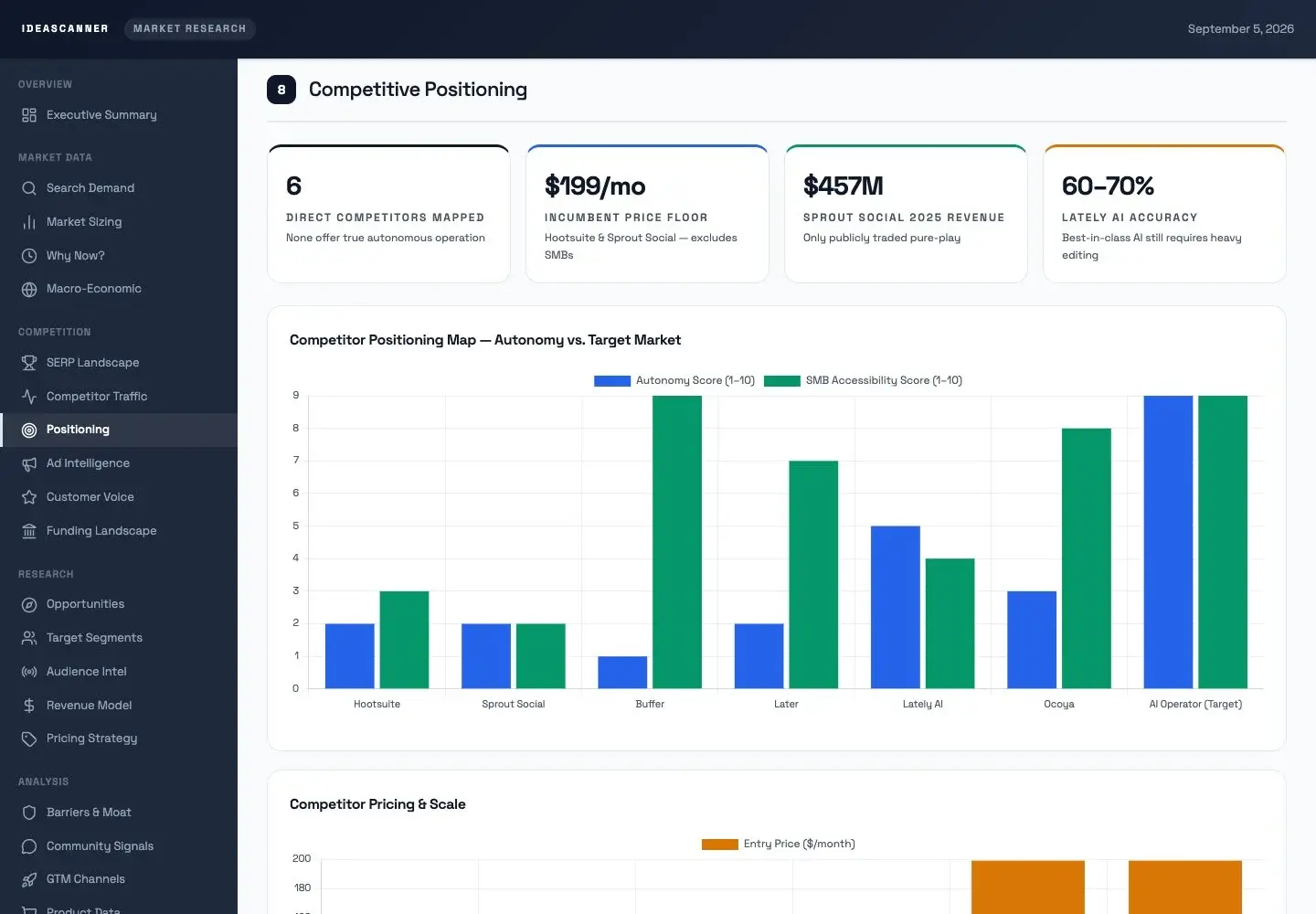
IdeaScanner is designed to turn those disconnected signals into a decision-ready market research report. It evaluates demand, competitor traffic, market sizing, pricing, ad activity, customer voice, and risk through live data sources, then ties the findings to a clear recommendation. That matters when the cost of a false positive is months of development and capital committed to a market that only looked attractive in isolated charts.
How to Turn Tool Data Into a Founder Decision
Set the decision criteria before researching. Otherwise, you will keep collecting favorable signals until the idea feels validated. Define what would make the market attractive: a minimum level of commercial search demand, evidence of reachable acquisition channels, pricing that supports your target economics, and a specific underserved customer segment.
Then look for contradictions. Strong traffic with weak review sentiment may signal a category ready for replacement, or it may signal customers are trapped by switching costs. High prices can mean attractive willingness to pay, or a service-heavy business disguised as software. Low competition can mean open space, or it can mean nobody has found a viable way to sell the product.
Create a simple evidence table for each conclusion. Record the claim, the supporting signals, the opposing signals, the confidence level, and the next test required. For example, “agencies will pay $299 per month” should not rest on a competitor's price page. It needs pricing evidence, agency-specific reviews, a clear buyer workflow, and ideally direct conversations or a paid pre-sale test.
The purpose of competitor research is not to produce admiration for companies that got there first. It is to expose the economics, demand, and weaknesses that determine whether you should enter, reposition, narrow the audience, or walk away. A fast no is often more valuable than a beautifully researched maybe.