Most founders do not have a pricing problem. They have an evidence problem. When people ask how to price new software, they usually want a neat formula. There isn't one. Pricing sits at the intersection of demand, alternatives, urgency, buyer economics, and positioning. If you guess on any of those, your price is just a story you are telling yourself.
That matters because bad pricing creates false signals. Charge too little and you may mistake weak value for strong demand. Charge too much and you may think the market rejected the product when the offer was simply misaligned. Early pricing is not just a revenue decision. It is market validation.
How to price new software starts with the market, not the spreadsheet
A lot of teams start with cost-plus logic. They estimate development time, add a margin, and call it a price. That approach works better for services than software. Buyers do not care what your sprint cycles cost. They care what problem goes away, what budget line your product fits into, and whether a cheaper substitute is good enough.
The first question is not, "What should we charge?" It is, "What else is the buyer comparing us against?" Sometimes that means direct competitors. Often it means manual workflows, spreadsheets, agencies, internal hires, or doing nothing for another quarter.
If your software saves a RevOps team ten hours a week, your ceiling is very different from a product that offers a mildly nicer dashboard. If it helps an agency close higher-value retainers, the price can rise with client economics. If it serves solo founders with thin budgets, willingness to pay may cap out even if the product is useful.
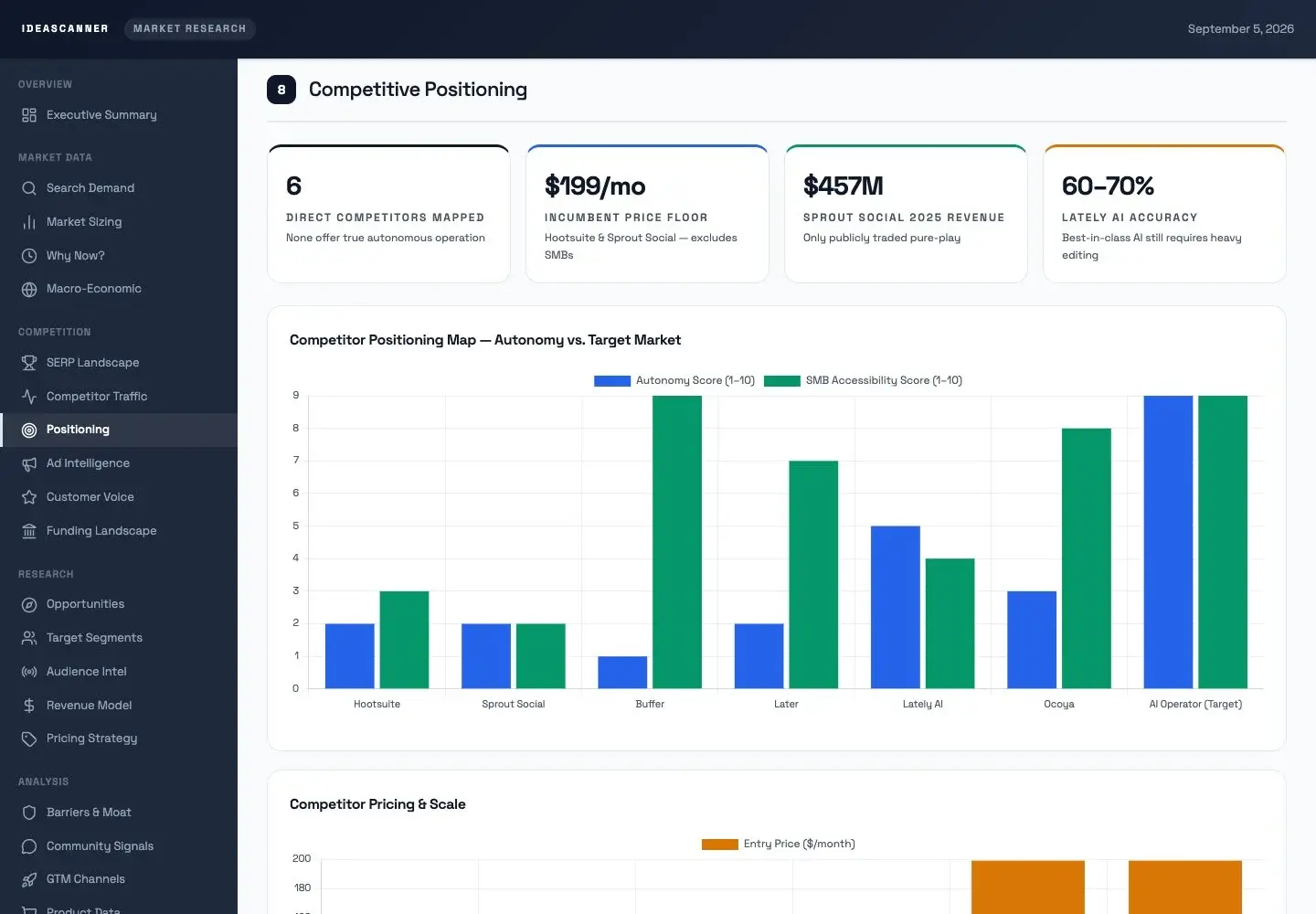
That is why pricing research should pull from multiple signals at once: competitor pricing pages, review complaints, feature packaging, search demand by problem type, ad intensity, and customer language about outcomes. One data point is anecdote. A pattern across several data sources is a pricing input.
What data actually matters
Founders often overvalue competitor list prices and undervalue buying context. A competitor charging $99 per seat does not mean you should. That number may reflect enterprise discounting, a legacy plan structure, or a different acquisition model.
The useful questions are more specific. What pricing metric does the market already understand: seats, usage, projects, locations, or revenue managed? Where are competitors hiding premium value behind custom plans? Which features consistently appear in higher tiers? What are customers praising, and what are they resenting enough to mention in reviews?
Search behavior also helps. If branded searches dominate the category, buyers may already trust a few incumbents and treat new vendors as riskier. That usually pushes newer products toward simpler pricing, stronger guarantees, or more generous entry plans. If problem-aware searches are high and the category is still fragmented, you often have more room to define pricing around a distinct use case.
Customer voice is where many pricing mistakes get exposed. Read enough reviews and you will see patterns quickly. People rarely complain only about price. They complain that the product is expensive for what it does, that the jump between tiers feels forced, or that they are paying for capacity they never use. Those are packaging problems disguised as pricing problems.
Set your price around value capture, not vanity
There are three basic anchors for software pricing: cost, competition, and value. Cost is the weakest. Competition is useful but incomplete. Value is the one that matters, though it is harder to quantify.
Value-based pricing does not mean charging the maximum possible amount. It means understanding how much of the created value you can realistically capture given category norms, switching friction, trust, and buyer risk.
If your product helps an ecommerce brand recover $8,000 a month in lost revenue, charging $49 a month is probably a signaling mistake. If your tool saves a freelancer a few admin steps each week, charging $1,500 a month is detached from buyer reality. The right price reflects both the outcome and the credibility of your product's role in delivering that outcome.
This is where new founders get trapped. They price off aspiration. They assume buyers will value the product the way they do. Markets do not reward internal conviction. They reward external proof.
Choose a pricing model your buyer can understand fast
The best pricing model is usually the one that maps cleanly to how customers already think about usage and budget. If the metric takes a paragraph to explain, friction goes up.
Seat-based pricing works when value scales with team adoption. Usage-based pricing works when output or transaction volume closely tracks customer value. Flat-rate pricing works when simplicity matters more than precision. Tiered packaging works when different customer segments clearly need different levels of capability.
There are trade-offs. Seat-based pricing can punish internal sharing and slow expansion. Usage-based pricing can create bill shock. Flat-rate plans are easy to sell but can leave money on the table. Tiered pricing is flexible but often becomes cluttered fast.
For new software, simpler is usually better. Not because simple is always optimal, but because early-stage pricing needs signal clarity. If your plan structure is too complex, you will not know whether low conversion came from the product, the price point, or the package itself.
Use competitors to frame the range, not copy the number
Competitive pricing research is still necessary. It helps you identify the acceptable range in the market and see where you can credibly position yourself.
If every serious alternative starts around $79 a month and you launch at $19, buyers may assume the product is lightweight, unstable, or missing something critical. Cheap can reduce trust just as easily as it increases clicks. On the other hand, if the market leader has spent years building brand authority and enterprise integrations, matching their price on day one can be hard to justify.
The useful move is usually to decide where you sit relative to the market and why. Maybe you are narrower but faster, so you charge less than broad incumbents while pricing above basic tools. Maybe you are premium because you solve a high-cost problem with unusual depth. The point is not to mirror the category average. It is to make your relative price make sense.
This is where disciplined market research helps. A pricing decision gets stronger when it is tied to competitor packaging, market saturation, and evidence of what buyers already pay for similar outcomes. That is more reliable than copying one pricing page and hoping the market agrees.
Test pricing like a market hypothesis
Pricing should be tested with the same skepticism you apply to product demand. Founders often ship one number and treat it as fixed truth. That is lazy. Price is a hypothesis.
Start by testing a narrow range, not random extremes. If your research suggests the market clears between $49 and $99, test within that band and watch conversion quality, not just signup volume. A lower price may increase trials while reducing retention, commitment, or expansion potential. A higher price may reduce top-of-funnel volume while improving customer fit.
You should also test packaging separately from price when possible. Sometimes conversion rises because a plan now includes the one feature buyers expected all along. That is not really price elasticity. It is offer alignment.
Qualitative feedback matters, but treat it carefully. People will tell you they would pay less. That is not insight. More useful signals are hesitation patterns, repeated objections, discount requests, and whether buyers compare your price to a human hire, another tool, or an internal workaround.
Common mistakes when figuring out how to price new software
The biggest mistake is pricing before you understand the market's reference points. Close behind it is assuming every user segment should see the same offer.
Early on, many products serve at least two different buyers: smaller self-serve users and higher-value teams with more urgent needs. If you force both into one plan, you usually undercharge one group and overcomplicate the other. Good pricing often starts by choosing which segment matters most right now.
Another mistake is hiding uncertainty behind discounts. If every sales call ends with a special deal, your list price is not real. You are collecting noise, not data. The same goes for copying enterprise pricing patterns too early. If you need custom quotes to make the economics work, your product or positioning may not be ready for self-serve.
Finally, do not confuse willingness to try with willingness to stay. Intro pricing can help acquisition, but if the value is not strong enough to support renewal at a sustainable rate, you did not solve pricing. You delayed the problem.
The founders who get pricing right are not psychic. They are stricter about evidence. They study alternatives, buyer language, market ranges, and value mechanics before they publish a number. If you want a cleaner answer on how to price new software, stop asking what feels fair and start asking what the market has already proven it will pay for. One clear price backed by real signals will beat a dozen optimistic guesses every time.