A product validation software review should not tell you that your idea sounds promising. That is not validation. Founders need to know whether buyers are actively looking for the problem, whether competitors can already satisfy the demand, what customers pay, and whether acquisition economics leave room for a business.
The standard is simple: can the software help you make a defensible Go, No-Go, or Narrow-the-Bet decision before you spend months building? If it cannot show where its conclusions came from, it is not diligence. It is a more polished form of speculation.
What Product Validation Software Must Prove
Most validation tools market confidence. Serious founders should look for evidence. The difference matters because a high-level trend chart, a few generated personas, or positive social comments can all create a false positive.
A useful platform connects multiple independent signals. Search demand shows whether people are trying to solve a problem. Competitor traffic and channel data show whether existing businesses can attract attention. Pricing intelligence reveals whether the category supports a viable offer. Customer reviews, forums, and support complaints expose the gaps that generic market summaries miss.
No single metric decides an opportunity. High search volume can indicate a mature, expensive category. Low search volume can still support a profitable B2B product if the pain is urgent and deal sizes are meaningful. The job of validation software is to make those trade-offs visible, not hide them behind a single attractive score.
The minimum evidence stack
Before treating a product idea as validated, expect the software to answer four questions with source-level support:
- Is there observable demand, and is it growing, flat, seasonal, or declining?
- Who already captures that demand, and how do they acquire customers?
- What do customers appear willing to pay, and what does the pricing model look like?
- What specific gap could a new entrant own without competing head-on with better-funded incumbents?
If a tool produces a recommendation without addressing these questions, the recommendation is premature. A confident answer with thin inputs is still thin.
Product Validation Software Review Criteria That Matter
The best product validation software is not necessarily the one with the most dashboards. It is the one that reduces the number of expensive unknowns fastest.
Live data beats generic AI output
AI is useful for framing hypotheses, summarizing review themes, and drafting research questions. It is weak when asked to declare a market attractive without current inputs. Language models can make an unsupported market thesis sound complete because their job is to generate plausible language, not verify commercial reality.
Look for platforms that pull current data from multiple sources rather than relying on a static dataset or a one-time AI prompt. Demand, ad activity, rankings, competitor traffic, and pricing change. A report built on live signals is not automatically correct, but it gives you something to inspect and challenge.
Source transparency is non-negotiable. You should be able to see the data behind major conclusions, understand what period it covers, and separate observation from interpretation. If a platform says competition is low, ask: low by what measure? Organic results, paid advertisers, funded companies, review volume, traffic concentration, or all of them?
A decision is more useful than a research dump
Raw data can become another form of procrastination. Founders do not need 40 disconnected charts. They need an explanation of what the evidence means for the specific product, customer, geography, and business model under consideration.
Strong software makes its assumptions explicit. A recommendation should state the attractive signals, the disqualifying risks, the confidence level, and the next test worth running. It should also distinguish between a market that merits a landing-page test and one that merits actual product development. Those are different decisions with very different capital requirements.
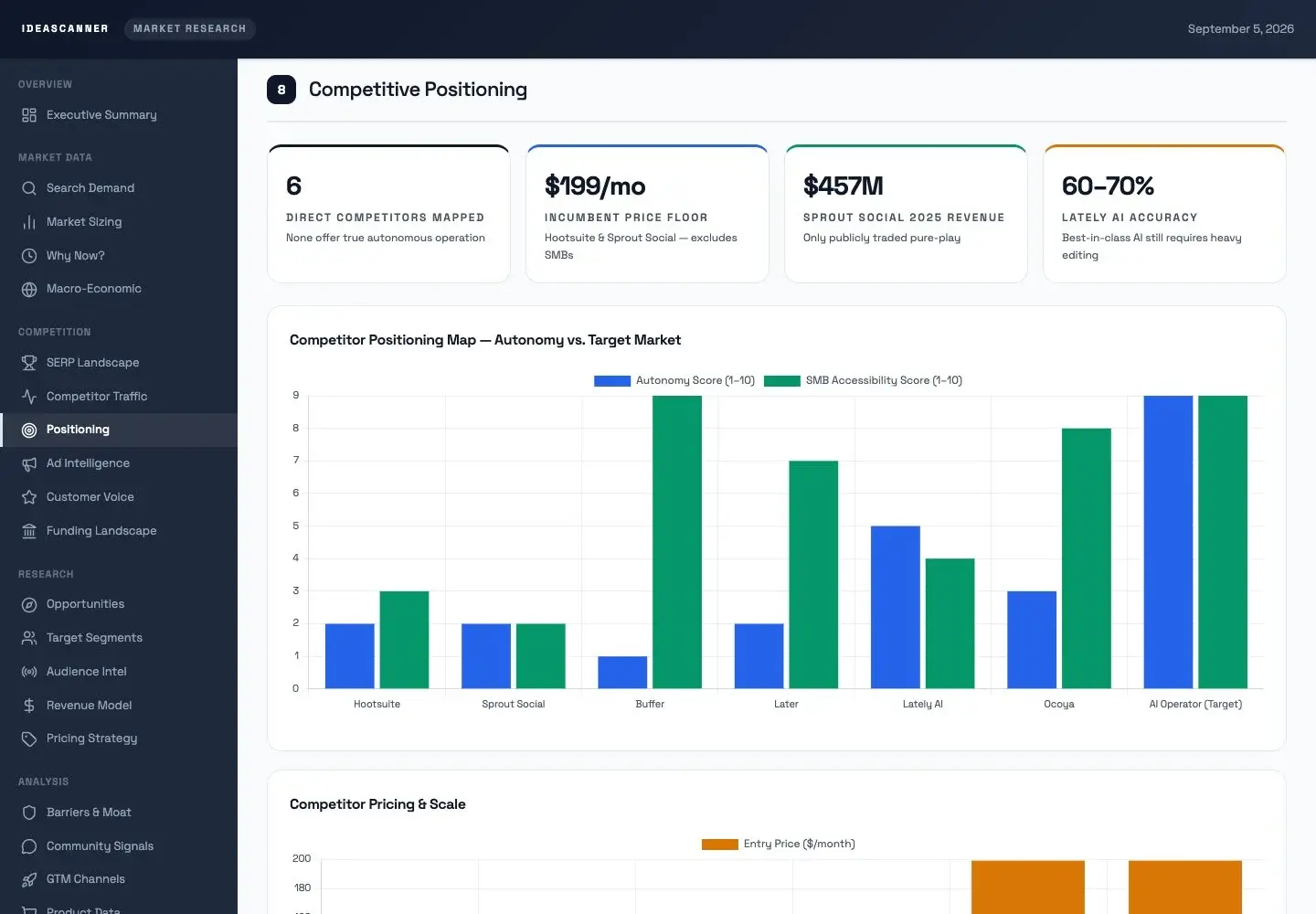
IdeaScanner is built around that distinction: a one-time, decision-ready report combines demand, competition, pricing, customer voice, market sizing, and risk signals into a clear recommendation instead of another open-ended research workspace.
Speed matters, but only when the work is deep enough
Manual diligence can consume several days. For a solo founder evaluating five ideas, that delay is costly. Fast research is valuable when it compresses collection and synthesis without removing the underlying evidence.
Be skeptical of instant results that claim certainty from a short prompt. Real validation requires cross-checking. A 30-minute report can be useful when software is collecting live data through established integrations and applying a consistent research framework. A 30-second verdict with no sources is a brainstorming aid, not market research.
Where Different Tool Types Help and Fail
There is no single category leader for every stage of validation. The right choice depends on whether you are screening ideas, planning a launch, or diagnosing why an existing offer is not converting.
Keyword and trend tools are good at measuring search behavior. They help estimate demand, identify language customers use, and spot seasonal patterns. Their weakness is context. Search volume does not tell you whether searchers buy, which competitors convert them, or whether a narrow segment is underserved.
Competitive intelligence platforms are useful for identifying traffic sources, paid acquisition patterns, and established players. They can reveal that a category is crowded before you enter it. But traffic estimates are directional, not audited financials. Treat them as comparative evidence rather than exact revenue data.
Customer research tools are strong for gathering interviews, surveys, and feedback. They help validate pain intensity and positioning. Their blind spot is sample bias. Friends, existing audiences, and respondents recruited through broad panels may not represent the buyer who will pay for your product.
All-in-one validation reports are most useful when you need a fast investment decision across several evidence types. Their quality depends on the breadth of sources, the freshness of data, and whether the final recommendation explains its logic. A bundled report is valuable only if it integrates signals rather than placing them side by side.
Test the Software Before You Trust Its Verdict
Do not evaluate a platform based on its homepage claims. Run it against a market you already understand. That is the fastest way to see whether its outputs are specific, current, and commercially literate.
Check whether it identifies recognizable competitors, accurate price points, and acquisition channels you know are active. Then inspect what it missed. A tool does not need to capture every detail to be useful, but systematic omissions matter. If it misses major competitors or confuses informational search demand with buying intent in a familiar market, it will likely misread an unfamiliar one too.
Next, use the same product concept with a different segment or geography. Good validation changes when the market changes. A scheduling platform for independent therapists, for example, is not the same opportunity as scheduling software for multi-location clinics. The buyer, budget, compliance burden, sales cycle, and incumbent set are different.
Finally, look at the actionability of the output. Can you turn the findings into a testable offer, a segment choice, a pricing hypothesis, or a reason to stop? If the report only tells you to conduct more research, it has not earned its cost.
Red Flags in Validation Claims
Watch for a few recurring failure modes. The first is a single composite score presented as proof. Scores can prioritize opportunities, but they cannot replace the underlying evidence. Ask what inputs drive the score and how heavily each input is weighted.
The second is inflated market-size logic. A massive total addressable market means little if your realistic first segment is small, difficult to reach, or already locked into incumbent contracts. Bottom-up market sizing, based on reachable buyers and plausible annual spend, is usually more useful than a large top-down number.
The third is confusing interest with intent. Likes, waitlist signups, survey responses, and broad search volume are all softer signals than a buyer accepting a price, booking a call, or changing behavior. Use software to narrow the field, then use a real market test to verify willingness to pay.
The Better Use of Validation Software
Treat product validation software as a decision system, not a permission slip. Its purpose is to identify what is true now, where the evidence is uncertain, and what test will resolve the uncertainty at the lowest cost.
A No-Go result can save more money than a positive one. It protects you from building for a market that is crowded, poorly monetized, inaccessible, or solving a problem buyers tolerate rather than pay to fix. A qualified Go is equally valuable because it tells you which segment, message, and channel deserve your first serious bet.
The founder advantage is not having more ideas. It is killing weak ideas early and allocating attention to opportunities that can survive contact with real market data.