Skip to content

Market research for founders

Find where your idea could win.

Understand demand, uncover potential market gaps, and decide what to test next—with a full research report built around your idea.

  • One-time payment, no subscription
  • Web report + downloadable PDF
  • Research-informed assessments and estimates
  • Emailed to you when ready

Before you commit

A good idea is not the same as a good opportunity.

An idea can be clever, useful and still land in a market that is already owned, priced out, or quieter than it looks. The difference sits in a handful of questions most founders have not answered yet, not because they are careless, but because the answers are scattered.

Demand
  • Are people searching for this problem, or only for the tools they already know?
  • Is interest rising, flat, or fading over the last year?
  • Do the searches show buying intent, or curiosity?

Where the answers live: keyword volumes, cost-per-click, trend lines, search results pages.

Customers
  • Who feels the pain hardest, and what do they use today?
  • What do they complain about in public reviews and forums?
  • What are they already paying, and to whom?

Where the answers live: review sites, community threads, competitor pricing pages.

Competition
  • Who owns the search results and the category name?
  • Where are incumbents weak: price, reliability, a missing capability?
  • What could kill this before it starts: a platform, a regulation, a well-funded rival?

Where the answers live: competitor traffic and ads, capability comparisons, funding data, public filings.

Some of these you can answer by talking to ten people. The rest live in data you would have to gather from a dozen places. A report does the gathering and lays it out so the conversations you have next are sharper.

None of this proves a market exists. It tells you where to look, and what would change your mind.

One idea, followed through a real report

What the research actually looks like.

Below is the public sample report, read in order: what it observed, what that implies, and what it suggested testing. These are research findings about one idea. We do not know what its founder did next, and we are not presenting it as a success story.

STOP 01

Is anyone searching for this?

Sample section: Search Demand
Observed

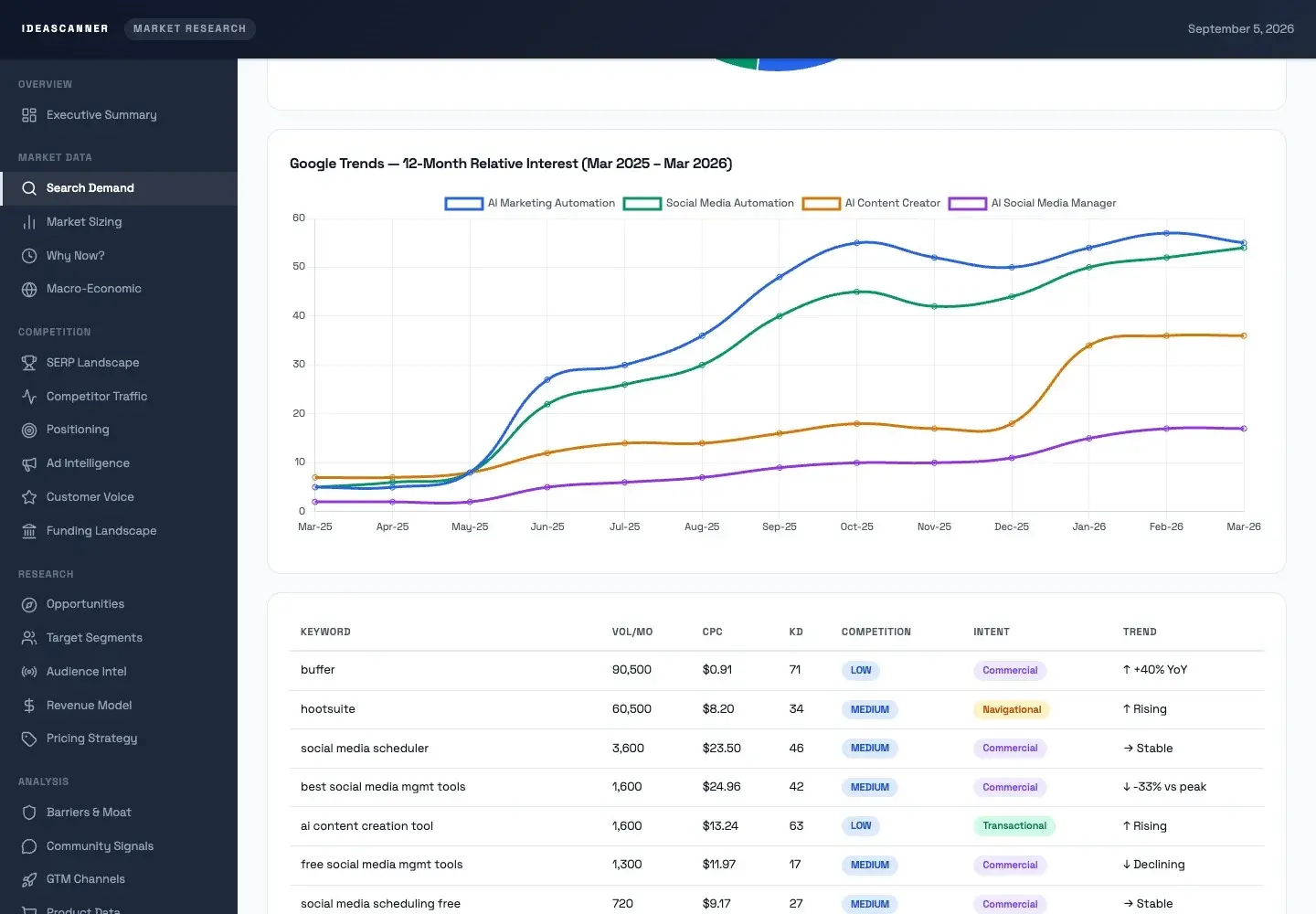
Brand searches for Buffer and Hootsuite dwarf every other query in the keyword table. The Google Trends chart shows "AI social media manager" climbing steeply across March 2025 to March 2026 while "best social media mgmt tools" has declined from its peak.

Implication

People know the incumbents by name. The AI-native phrasing is new, growing, and not yet attached to any product. That is interest, not demand for this product.

Suggested test

Small paid-search test on the AI-native queries to see whether those searchers sign up for anything, before assuming they will.

Sample · Search Demand pagePublic sample
Search Demand page of the public sample report: header, section sidebar, a 12-month Google Trends line chart for four queries, and a keyword table with volume, CPC, difficulty and intent.
Real capture with the report's own header and sidebar. Example assessments for one idea, not a customer result.Open full-size capture · This section in the sample
STOP 02

What do current customers complain about?

Sample section: Customer Voice & Reviews
Observed

The sample compiles public reviews of six tools and groups the complaints into themes. Manual effort is the most common: scheduling works, but writing, planning and choosing what to post still falls on the user.

Implication

The pain the idea targets is real and already articulated by paying customers of other tools. It also sets the bar: "AI features" that amount to caption rewriting were called out as overclaims.

Suggested test

Use the themes as interview prompts. Ask ten current Buffer or Hootsuite users what they still do by hand each week, and what they would pay to stop.

  • 01Manual effortScheduling is solved; content planning and writing are not.
  • 02Generic AI outputSuggestions ignore brand voice and need a full rewrite.
  • 03No learning loopTools do not learn what performed; every week starts from scratch.
  • 04Price shock and price-to-valueEnterprise-tier pricing for what is still a scheduler.
  • 05Analytics gapReports show what happened, not why, or what to do next.
  • 06ComplexityLong onboarding; team members avoid the tool.

Themes as labelled in the sample's review table. The sample notes that direct review scraping was blocked for some tools and it relied on aggregated review data and public discussions; treat individual quotes there as illustrative.

STOP 03

Who already serves them, and where are they weak?

Sample section: Competitive Positioning
Observed

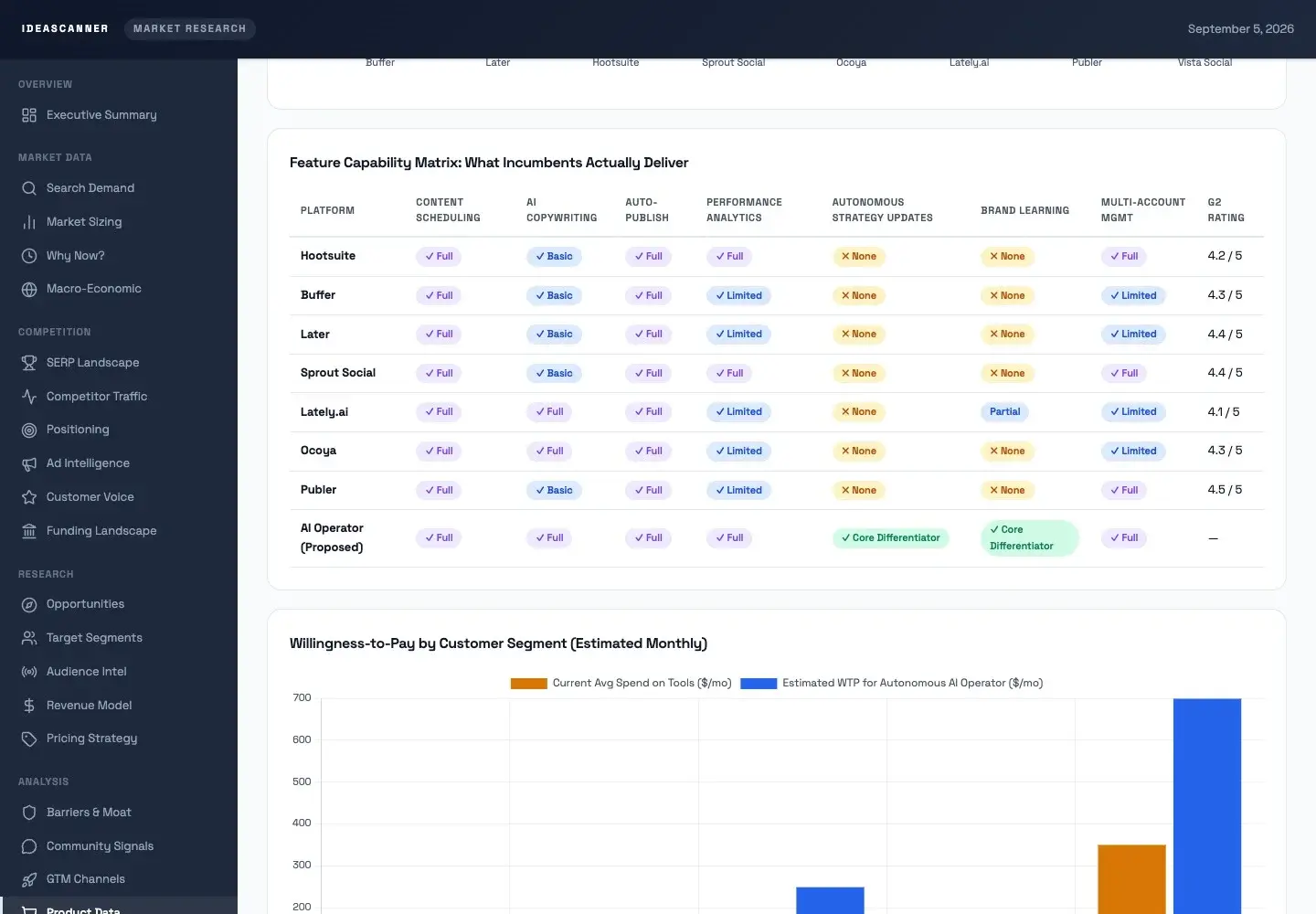
Six incumbents are mapped with entry price, differentiator and a "fatal weakness" column. The capability matrix rates their AI autonomy as none or minimal; each is strong at scheduling and publishing. Entry prices run from a free tier to $199 a month.

Implication

The market is crowded at the scheduler layer and, on this evidence, empty at the agent layer. That is a positioning opening, and also a warning: incumbents have distribution and can ship AI features quickly.

Suggested test

Pick the one capability incumbents lack and make it the demo. If prospects cannot tell it apart from "AI captions", the positioning is not working.

Sample · Product & Market Data pagePublic sample
Product and Market Data page of the public sample report: header, section sidebar, a feature capability matrix comparing seven platforms across eight capabilities, and the start of a willingness-to-pay chart.
Real capture with the report's own header and sidebar. Example assessments for one idea, not a customer result.Open full-size capture · This section in the sample
STOP 04

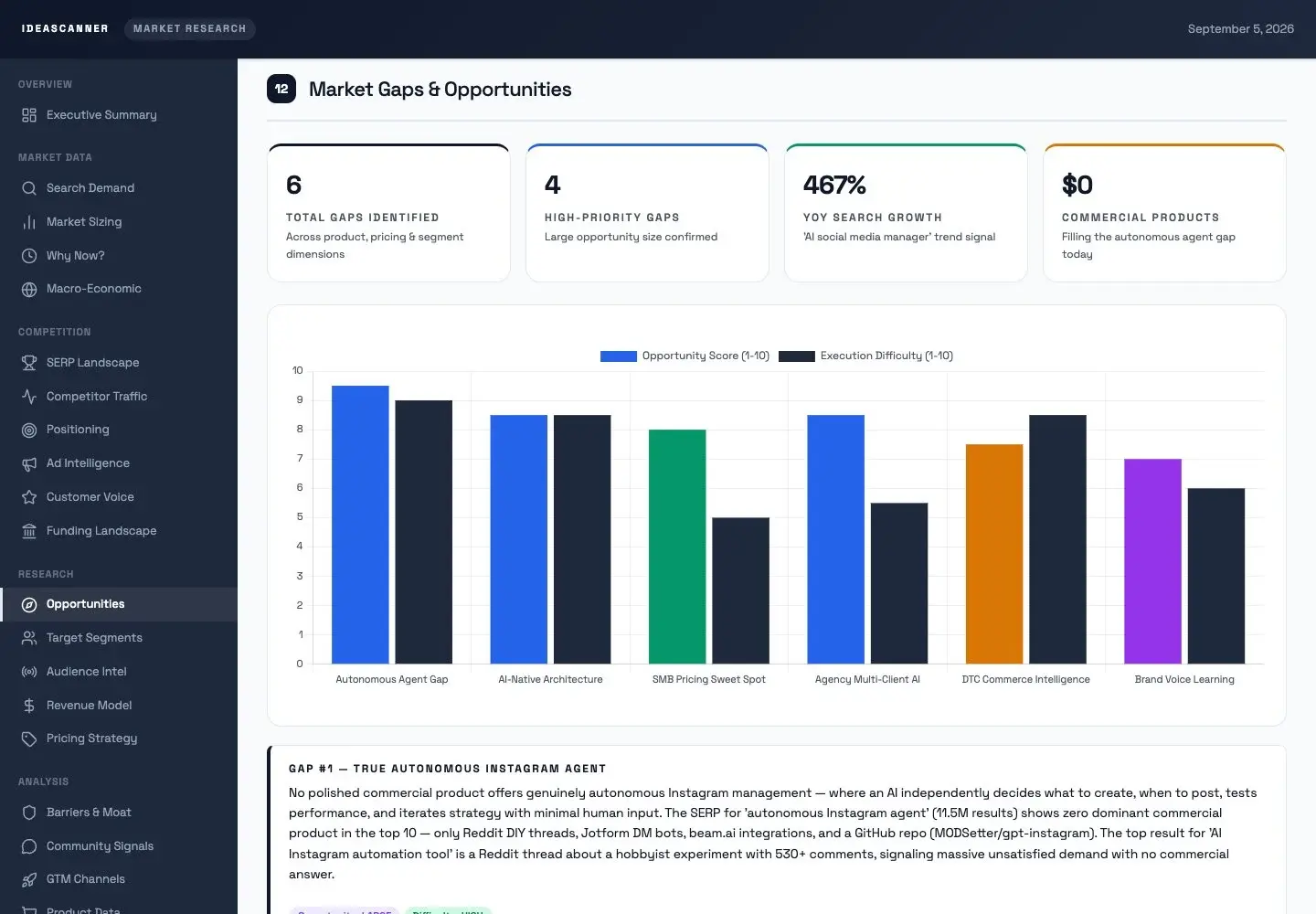
Where are the gaps, and how hard are they?

Sample section: Market Gaps & Opportunities
Observed

The sample names six gaps and scores each for opportunity, difficulty and priority. Its first gap rests on a search-results check: the top results for "autonomous Instagram agent" were Reddit threads, a GitHub repository and DM bots, not a polished commercial product.

Implication

Absence from sampled search results is a hypothesis about the category, not proof nobody is building it. The score tells you where to look first; the difficulty rating tells you what it will cost to find out.

Suggested test

Discovery interviews before building. The sample's own next-steps list schedules twenty of them in the first six weeks and says not to build before that data is in hand.

Sample · Market Gaps & Opportunities pagePublic sample
Market Gaps and Opportunities page of the public sample report: header, section sidebar, a bar chart scoring six gaps by opportunity and execution difficulty, and the written description of the first gap.
Real capture with the report's own header and sidebar. Example assessments for one idea, not a customer result.Open full-size capture · This section in the sample
STOP 05

What would it cost, what could it charge, and where to start?

Sample sections: Pricing, Go-To-Market, Go / No-Go
Observed

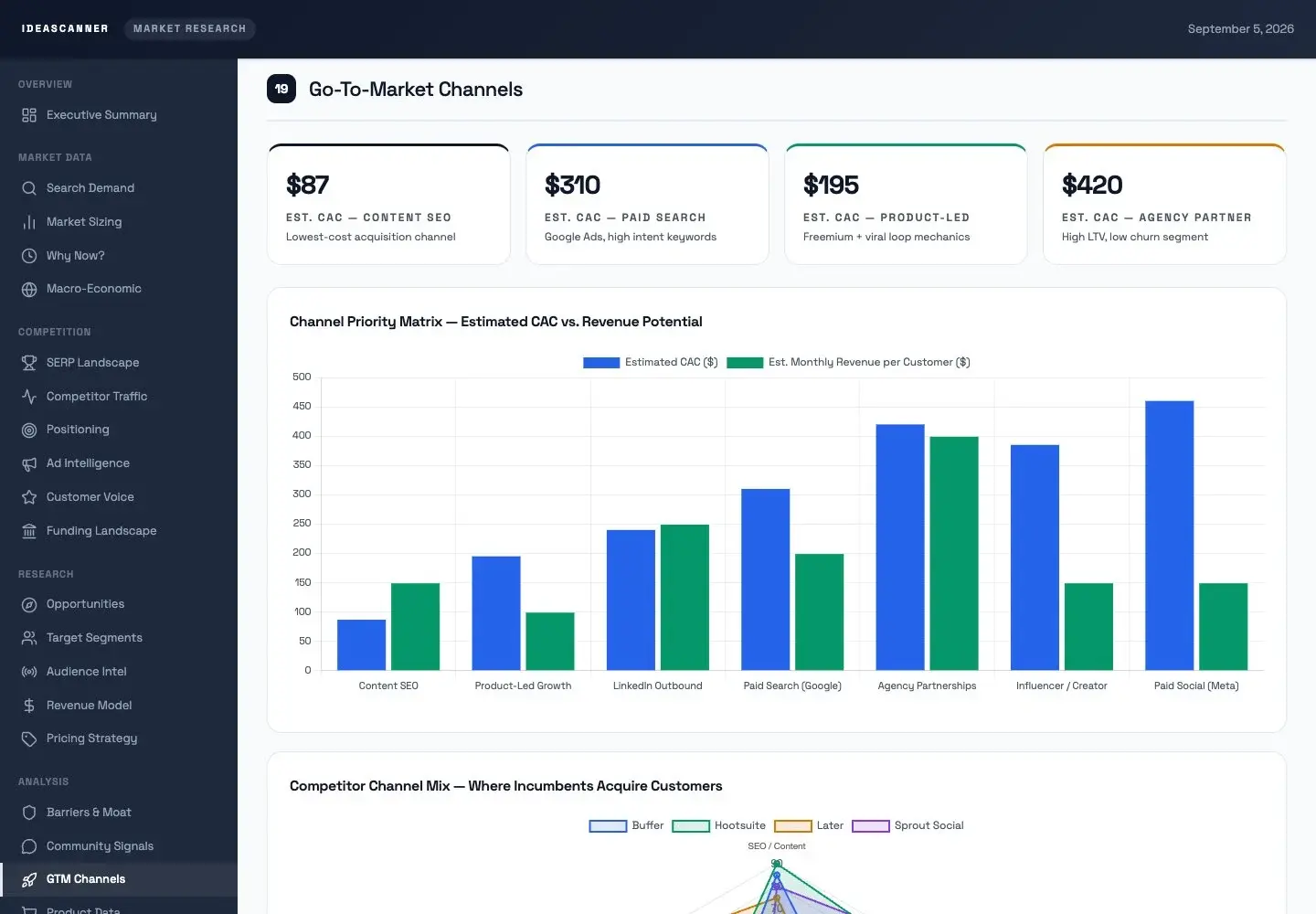
The pricing section lays incumbents' entry, mid and agency tiers side by side and proposes a $49 solo and $99 small-business tier for the idea, between the cheapest schedulers and the $199-and-up enterprise floor. The channel section ranks content SEO and a product-led free trial as the first two channels to try, with estimated acquisition costs.

Implication

A price and a first channel are now specific enough to be wrong. That is the point: they can be tested in weeks, not argued about for months.

Suggested test

Waitlist landing page within two weeks positioned as "set-and-forget Instagram management", distributed through founder communities, and a price check inside the discovery interviews.

The sample's verdict

"Go", with a devil's-advocate section that rates overall risk high.

The risk section names Meta's API control as a single point of failure and expects incumbents to ship their own AI. A "go" here is a plan to test under known threats, not a promise the business works.

Its first ninety days, in short
  1. Claim the category language in search before incumbents do.
  2. Launch a waitlist page and run small paid tests to learn a cost per signup.
  3. Twenty discovery interviews across the four segments; validate the price.
  4. Only then build a narrow Instagram-only version.
Sample · Go-To-Market Channels pagePublic sample · estimates
Go-To-Market Channels page of the public sample report: header, section sidebar, estimated acquisition-cost tiles, and a bar chart comparing channels by estimated cost and revenue potential.
Real capture with the report's own header and sidebar. Example assessments for one idea, not a customer result.Open full-size capture · This section in the sample

Opportunities

Gaps are hypotheses worth testing, not verdicts.

The report looks for three kinds of opening. Each one comes with the evidence behind it and the reason it is still only a starting point. Here is how that reads in the public sample.

Competitors' weaknesses

What the sample observed
Each incumbent gets a named weakness: per-seat pricing that punishes agencies, unreliable account connections on cheaper tools, AI that amounts to a caption rewriter, long onboarding on the enterprise products.
Why it is a hypothesis
Weaknesses are drawn from public reviews and pricing pages at one moment. Incumbents fix things, and reviewers skew toward the unhappy. Confirm the complaint with the people you would sell to.

Underserved segments

What the sample observed
Solo founders and small internet businesses are described as priced out of enterprise tools and let down by the affordable ones; agencies managing many accounts are squeezed by per-seat plans. Four segments are profiled with pain points, channels and an estimated willingness to pay.
Why it is a hypothesis
Segment sizes and willingness to pay in the sample are estimates, not measured. They tell you which group to interview first, not what they will spend.

Positioning gaps

What the sample observed
"AI-native operator" versus "scheduler with AI bolted on", and a price tier the sample calls reliable, affordable and genuinely AI-powered, sitting between the cheap tools and the enterprise floor. Nothing in the sampled search results occupied either position.
Why it is a hypothesis
Absence from search results does not prove absence from the market. A position is only real once customers can repeat it back and choose you for it.

Your report will find different gaps, and possibly fewer. What stays the same is the shape: an observation, the evidence behind it, and the test that would confirm or kill it.

Gap counts and scores vary by idea and by the data available. The sample shows six; yours may show more, fewer, or none worth pursuing.

What to do next

Evidence changes what you build, not just whether.

Five moves a report can push you toward. Each row shows what the public sample suggested for its idea, and how you would test the same move for yours.

  1. 01

    Narrow the audience

    What the sample suggested

    Of four profiled segments, start with solo founders and small DTC brands: the largest group, the most vocal about manual work, and reachable through founder communities. Target Segments

    How you would test it

    Interview the one segment first. If their weekly pain and current spend match the report, keep going; if not, try the next segment before changing the product.

  2. 02

    Change the positioning

    What the sample suggested

    Say "operator, not scheduler" and make brand-voice learning and self-optimisation the visible difference, since the capability matrix shows incumbents without them. Competitive Positioning

    How you would test it

    Two landing-page variants, one framed as a better scheduler and one as an operator. Compare signup quality, not just clicks.

  3. 03

    Test the price

    What the sample suggested

    A $49 solo tier and $99 small-business tier, placed between cheap schedulers and the enterprise floor, to be validated in the discovery interviews rather than assumed. Pricing & Willingness to Pay

    How you would test it

    Show the price on the waitlist page and in interviews. Willingness to pay in the report is an estimate; a pre-order or a "yes at that price" in conversation is the data.

  4. 04

    Try an acquisition channel

    What the sample suggested

    Content SEO on the unclaimed AI-native phrases and a product-led free trial first; paid search on the same phrases as a quick benchmark. Channel costs are estimates. Go-To-Market Channels

    How you would test it

    One channel, one budget, one metric: cost per qualified signup. Stop or scale on the number, not on the report's estimate.

  5. 05

    Rethink the idea

    What the sample suggested

    The devil's-advocate section rates overall risk high: platform API access can be revoked, and incumbents will ship their own AI. It recommends platform-agnostic architecture and a human approval step for risky actions. Risk Assessment

    How you would test it

    Decide in advance what would make you stop: a failed price test, a platform policy change, an incumbent launch. A no-go report ends with next steps too.

What you buy, and its limits

Research support. Not proof.

A structured research report about one idea, gathered from public sources and organised by AI-assisted analysis, with assessments and next steps. Here is how it is made, where it looks, and what it cannot do.

How it works

  1. Describe your idea

    A short guided form: what you want to build, who it is for, and what you already know or suspect. Plain language is fine.

  2. We research it

    AI-assisted research gathers available search data, competitor information, pricing and public discussion themes, then structures the findings into a report. Data coverage varies by idea.

  3. Read the report

    We email you when it is ready. Open it in the browser or download the PDF and share it with a co-founder, advisor or investor.

    Timing varies with the idea's scope; you will get an email either way.

Source categories used in the public sample

  • Search dataKeyword volumes, cost-per-click and 12-month trend lines
  • Search results pagesWho ranks for the category's phrases, and who does not
  • Review sitesAggregated ratings and complaint themes across competitors
  • Community discussionReddit, Product Hunt, Indie Hackers and Hacker News threads
  • Competitor pricing and trafficPublic pricing pages, traffic and channel estimates
  • Funding and filingsFunding data and, where a rival is public, its own risk disclosures
Recorded from sources
  • Keyword volumes and cost-per-click at the time
  • Competitor list prices and plan structures
  • What appeared in search results for a phrase
  • Review themes and ratings as aggregated
Estimated or assessed
  • Market and segment sizes
  • Willingness to pay and acquisition costs
  • Revenue scenarios and payback periods
  • Gap scores, confidence scores and the go / no-go call

Coverage differs by idea. Some sections in your report may lean on estimates where public data is thin, and the report says so where it does.

What it is not

  • Not proof that demand exists, or that it exists for your version of the idea.
  • Not a guarantee of customers, revenue or a successful launch.
  • Not a substitute for talking to customers; it is preparation for it.
  • Not a fixed number of sections or gaps; both vary with the idea and the data.
  • Not fully verified: AI-assisted analysis can contain errors, so check important figures before acting on them.
  • Not a live quote of the market: numbers are as recorded when the report was generated.

From Trustpilot reviews

What people said
after reading theirs.

A few words from people who used IdeaCrystal to think through their next business move.

…it isn’t blindly optimistic.
★★★★★Amir FriedmanExcerpt · TrustpilotRead full review ↗
Validated my core concept while warning me about market saturation.
★★★★★Hadas KorenExcerpt · TrustpilotRead full review ↗
…not having to try to do it all alone…
★★★★★TiffanyExcerpt · TrustpilotRead full review ↗

A simple offer

One full report.
One payment.

Research the idea in front of you. Everything below is included in your full report.

The full market research report

Specific to your idea. Ready to read, share, and act on.

  • Demand and search signals
  • Competitor landscape
  • Customer pain and market gaps
  • Market sizing and assumptions
  • Pricing reference points
  • Risks and opportunities
  • Recommendation and next steps
  • Supporting references
  • Web report + downloadable PDF
  • Email when your report is ready

Full report

$37

One-time payment · USD

  • One idea, fully researched
  • No recurring subscription
  • Web report + PDF included

Who you are buying from

OPSSNODE LTD, a company registered in Cyprus (EU).

Reg. No: HE 488232
Elpidas, 8, Pyrgos, 4534, Limassol, Cyprus

Questions before or after

support@ideacrystal.com

Founder: Adir Semana

Adir Semana, founder of IdeaCrystal
Adir Semana · Founder

A note from the founder

A founder behind
the research.

“I built IdeaCrystal because I know how easy it is to confuse a good-sounding idea with a good business decision.”

As a technical founder, I could build almost anything. That was part of the problem. The hard part was knowing which direction had real market pull before committing months of work, budget, or team focus.

IdeaCrystal is the report I wanted before starting: market research organised, potential openings explored and risks named, so you have a clearer starting point for your decision.

Adir SemanaFounder, IdeaCrystal · Previously founder & CTO, Geonode
LinkedIn profile ↗

Questions

Straight answers.

What exactly do I receive?

A web report and downloadable PDF exploring demand, competitors, potential market gaps, customers, pricing, risks and recommended next steps. Depth varies with available data. We email you a link when it is ready.

What does AI-assisted research mean?

AI helps gather, interpret and organise available search data, competitor information, pricing and public discussion themes. The output is a structured research report with assessments and suggested next steps. Coverage varies with the data available.

How accurate is the report?

Accuracy depends on available data and AI-assisted analysis, which can contain errors. Estimates and recommendations involve assumptions. Use the report to guide further research and customer conversations, and verify important figures before acting.

How long does it take?

Timing depends on the scope of the research and current demand. We email you when your report is ready, so you do not need to stay on the page.

Is this a subscription?

No. The full report is a one-time payment of $37 for one idea. There is no recurring subscription to cancel.

What if the research does not support my idea?

That can be useful too. The report explains the risks and recommends next steps, helping you decide what to change or test before committing further.

Can I see a complete example first?

Yes. Read the full sample report to see the format and depth before you buy.

What if I have a problem with my order?

Email support@ideacrystal.com. You can also read our refund policy before ordering.