A market can look promising right up until you price the product, map the competitors, and realize demand is broad but weak. That is why the real question is not just whether a market is large. It is what makes a market attractive enough to justify your time, capital, and focus.
Founders get this wrong in predictable ways. They confuse interest with intent, market size with accessibility, and competitor presence with validation. Sometimes those assumptions work. More often, they create expensive false positives. An attractive market is not the one that sounds exciting in a pitch. It is the one where demand is visible, customers can be reached, margins are defendable, and the path to entry is realistic.
What makes a market attractive in practice
Attractive markets have a specific profile. They show evidence of real customer pain, not just curiosity. Buyers are already spending money, search behavior suggests active demand, and competitors have proven there is a business model to study. At the same time, the market is not so crowded or structurally difficult that a new entrant has no room to win.
That last part matters. Founders often want a market with no competitors because it feels open. In reality, no competition can mean no demand, unclear positioning, or a buyer problem that is not urgent enough to fund. On the other hand, a crowded market with entrenched leaders can be just as bad if customer acquisition costs are high and switching friction is severe. Market attractiveness lives in the middle ground between validation and saturation.
A useful way to think about it is this: a market is attractive when demand, economics, and timing align. If one of those breaks, the opportunity usually weakens fast.
Demand is the first filter, not the only one
The clearest signal is demand. But demand needs to be qualified.
Search volume can reveal whether people are actively looking for a solution. Traffic patterns across competitor sites can show whether that demand is consistent or inflated by a short-lived trend. Review volume, forum discussions, and customer complaints can expose whether the problem is painful enough that people keep searching for alternatives.
Still, raw demand is not enough. A market with high interest but low purchase intent can waste months of work. For example, informational queries can look encouraging while commercial intent remains weak. If people want advice, comparisons, and free tools more than they want to buy, that changes the attractiveness of the market immediately.
Good demand has three qualities. It is discoverable, commercial, and persistent. Discoverable means you can measure it through search, traffic, communities, or transaction signals. Commercial means buyers are not just browsing. Persistent means demand is not dependent on a temporary news cycle, platform shift, or one viral product.
Market size matters less than reachable market size
A huge total addressable market is one of the most abused concepts in startup planning. It sounds impressive and often means very little.
What matters more is reachable demand within a specific segment you can serve better than incumbents. If the market is worth billions but your realistic first wedge is a narrow niche with weak buying power, the headline number is useless. Attractive markets are not defined by the largest top-down estimate. They are defined by whether a focused customer segment is large enough to support growth and accessible enough to win.
This is where segmentation sharpens judgment. A broad market may be unattractive overall but highly attractive in one underserved subcategory. The reverse is also true. A booming category may hide a segment where pricing is collapsing and differentiation is disappearing.
Founders should ask a harder question than how big the market is. Ask how much of it is reachable in the next 12 to 24 months through the channels, budget, team, and product constraints you actually have.
Competition is a signal, but structure decides the opportunity
Competitive presence is useful because it proves somebody has already educated the market. It can also reveal how buyers compare options, what claims matter, and where incumbents are weak.
But not all competition creates the same challenge. Ten fragmented competitors are very different from two dominant platforms with locked-in distribution. An attractive market can tolerate heavy competition if customer loyalty is shallow, products are poorly differentiated, or buyers are openly dissatisfied. A less competitive market can still be unattractive if regulation, channel access, or trust barriers make entry difficult.
The right question is not whether competition exists. It is whether the market structure leaves room for a meaningful wedge.
What to look for in competitor analysis
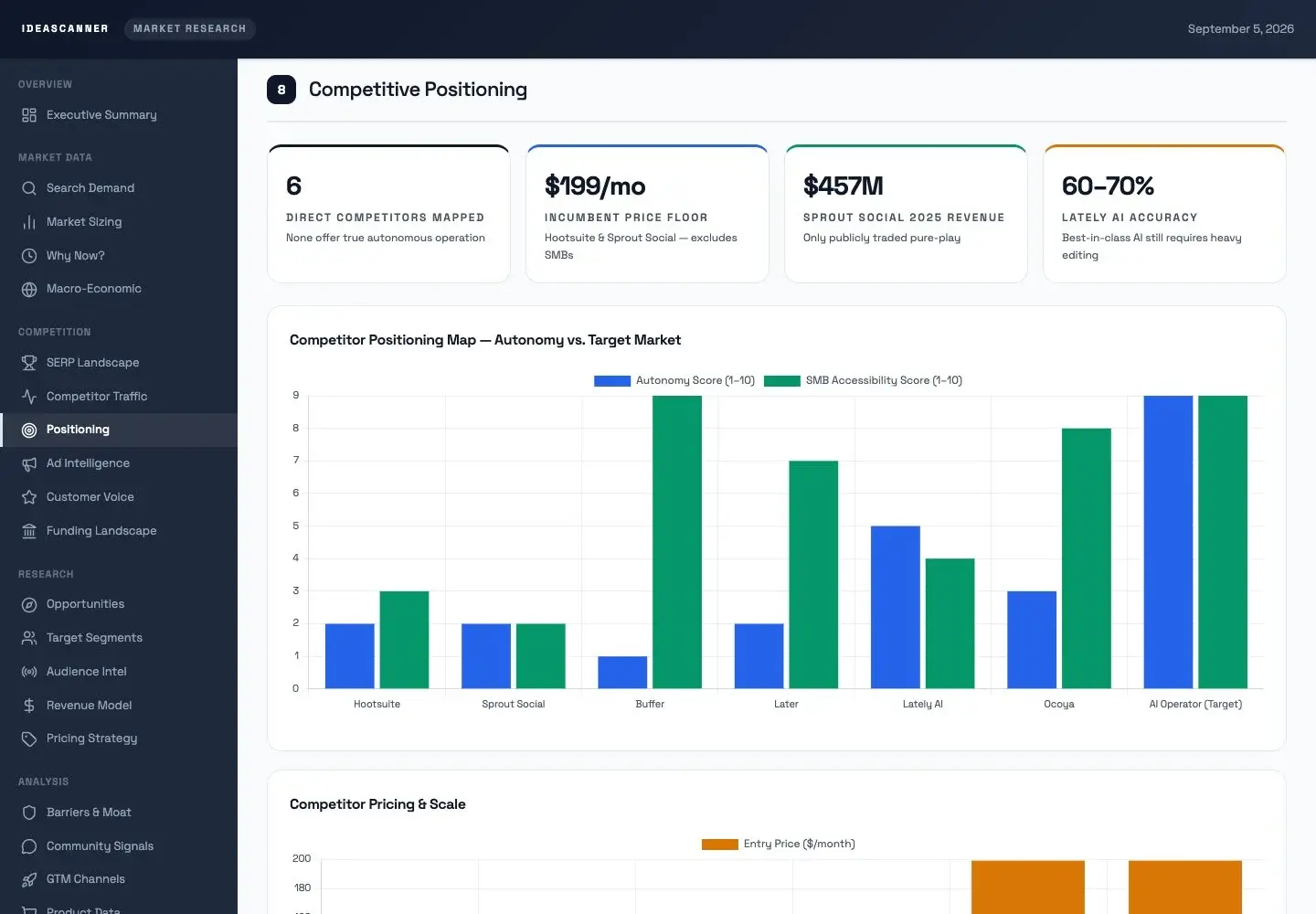
Traffic concentration matters. If a few players control most category traffic, acquisition may be expensive. Pricing spread matters too. If the market supports multiple price points, that often suggests room for segmentation and positioning. Product gaps matter most of all. Negative reviews, weak onboarding, poor support, or narrow feature sets can expose openings that a new entrant can exploit.
This is where shallow research fails. A generic answer might tell you a market is competitive. That is not useful. You need to know how competitors win, which channels drive them, how they price, and where customer dissatisfaction is concentrated.
Attractive markets support healthy unit economics
Founders sometimes enter markets they can technically serve but cannot profit from. That is not an attractive market. It is a trap with demand.
Unit economics bring discipline to the analysis. If customer acquisition costs are rising, margins are thin, and retention is uncertain, even a large market can become unattractive. On the other hand, a smaller market with strong average order values, repeat purchase behavior, or expansion revenue can be far more compelling.
Pricing intelligence is a useful shortcut here. If competitors struggle to maintain premium pricing and the category is racing to the bottom, attractiveness drops. If buyers tolerate high prices because the problem is urgent or ROI is obvious, attractiveness improves.
The key is not whether revenue is possible. It is whether the market leaves enough economic room after acquisition, delivery, and support costs are accounted for.
Timing can improve or destroy market attractiveness
Some markets are attractive on paper and wrong in timing. Others look crowded but are opening because the rules are changing.
Timing shows up in signals such as rising search demand, new regulation, shifts in ad activity, changes in customer behavior, or technological change that lowers delivery costs. A market entering an expansion phase often gives new entrants more room because buyers are still exploring options and category leaders have not fully consolidated power.
The opposite is also common. A once-attractive market may be deteriorating because paid acquisition is saturated, the product has become commoditized, or platform dependence has become dangerous. If a market only works under a narrow set of external conditions, its attractiveness is fragile.
This is why trend analysis matters, but hype should be discounted hard. Sharp growth over six months is not enough. You need to know whether demand is compounding, peaking, or merely reacting to noise.
Risk is part of the answer to what makes a market attractive
A market is only attractive relative to its risk profile. Strong demand does not cancel operational, legal, or channel risk.
If a business depends on one acquisition channel, one policy environment, or one supplier class, the opportunity is more brittle than it appears. If customer expectations are expensive to meet or retention depends on constant discounting, that risk should reduce the attractiveness score. Likewise, if the market requires long sales cycles, deep domain trust, or compliance overhead, founders need to price those realities into the opportunity.
Risk should not automatically eliminate a market. It should force precision. Some risks can be managed through niche positioning, pricing strategy, or a different go-to-market motion. Others are structural and hard to avoid.
A simple standard for founder decisions
If you are evaluating a new market, do not ask whether it sounds promising. Ask whether the evidence supports a practical go decision.
An attractive market usually checks five boxes. Demand is visible and commercial. The reachable segment is large enough to matter. The competitive structure leaves room to differentiate. Unit economics can work without heroic assumptions. The timing and risk profile are still favorable when you strip away optimism.
That standard is stricter than most founders use, which is exactly the point. Good markets do not just have upside. They have enough evidence to reduce the chance of building into a dead end.
For teams that need a faster answer, that is where a platform like IdeaScanner fits naturally. Not as a source of comforting validation, but as a way to pressure-test the market using live demand, competitor traffic, pricing, customer voice, and risk signals before resources get locked in.
A market becomes attractive when the data says there is room to win and the downside is legible enough to manage. If you cannot explain both with evidence, you are not looking at an opportunity yet. You are looking at a guess.